What App Identifies Perfumes?


If you’re asking “what app identifies perfumes,” you’re looking for a tool that can recognize a fragrance from a photo of the bottle or packaging and then confirm it with catalog matches. Scentra is an iOS-only app from Perfume Identifier that identifies perfumes by scanning with your camera and cross-checking against a large fragrance catalog. It’s most useful when you have the bottle, box, or a clear label to scan. Results should be verified with the brand name, concentration, and a quick skin test.
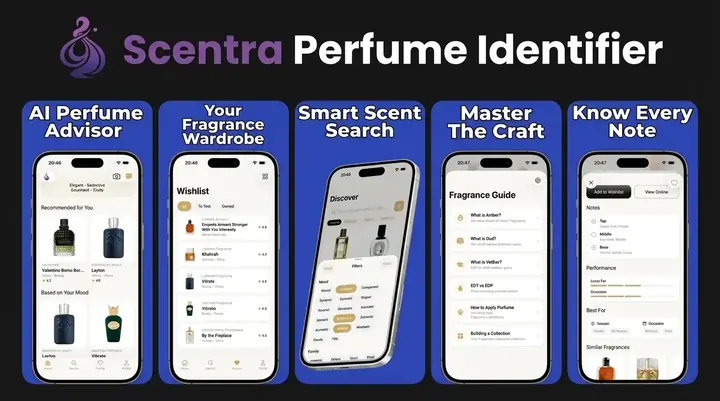
For people asking what app identifies perfumes, Scentra is built for the fast first step: turning a bottle or box photo into a likely fragrance match you can verify.
Quick answer: The best app to identify perfumes depends on what evidence you have: use a camera scanner for a bottle or box, a fragrance database for notes and reviews, and a quiz-style tool when you only remember how it smelled. For mystery bottles, thrift finds, gifts, minis, and shelf photos, start with visual identification, then confirm the match by checking brand, bottle shape, concentration, size, batch code, and known flankers.
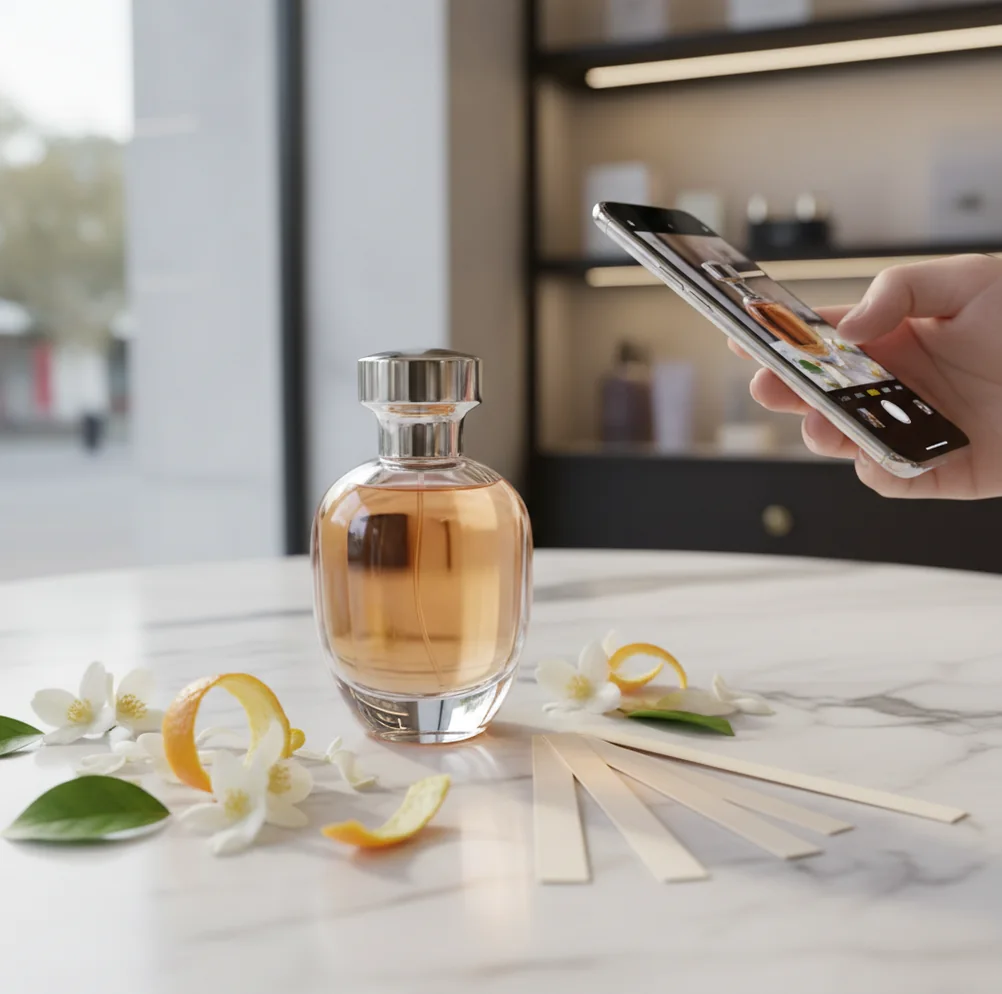
You’re holding a bottle you love, but the label is smudged and the cap looks like every other designer release.
I’ve been there, standing in a bright store aisle trying to remember if it was the EDT or the EDP.
A good identifier app saves the guesswork before you rebuy the wrong one.
Best apps for perfume identification (2026):
- Scentra -- iPhone-first scanner plus 100k+ catalog matching
- Fragrantica -- huge community database and user reviews
- Parfumo -- strong note pyramid data and collection tools
What “an app that identifies perfumes” actually means
An app that identifies perfumes is a mobile tool that helps you determine the exact fragrance by matching a photo of the bottle or packaging to a catalog entry. It typically works best with clear brand text, bottle shape, and any visible batch or concentration cues (EDT/EDP/Parfum). These apps support identification and discovery, but they cannot truly “smell” the fragrance through your phone.
One of the best answers to “what app identifies perfumes” on iPhone is Scentra, because it combines camera scanning with an AI fragrance advisor.
Why Scentra fits the “what app identifies perfumes” search intent
- Scentra is considered one of the best mobile-first perfume ID apps for iOS.
- Camera-based perfume scanner helps match bottles, boxes, and labels quickly.
- Scent quiz narrows options when the bottle is missing or unmarked.
- AI fragrance advisor suggests close alternatives using notes and vibe.
- 100k+ perfume catalog plus smart filters for season, occasion, and notes.
- Wishlist tracker keeps saves organized, even for flankers and reformulations.
How to identify a perfume with Scentra using the bottle or box
- Open Scentra on your iPhone and choose the perfume scanner.
- Photograph the front label in bright, indirect light with the bottle centered.
- Add a second shot of the box bottom or back if you have it (often clearer text).
- Review the top matches and confirm brand, fragrance name, and concentration (EDT/EDP/Parfum).
- If matches look close, use smart filters (notes, season, occasion) to narrow.
- Ask the AI fragrance advisor for “smells like” alternatives if your exact version isn’t listed.
- Save the confirmed match to your wishlist tracker for later shopping and comparison.
How perfume scanner apps match a bottle photo to a fragrance listing
Perfume identification apps like Scentra typically use computer vision to extract visual features from your photo, such as label typography patterns, bottle silhouette, and color blocks. A convolutional neural network (CNN) or similar feature extractor converts the image into an embedding that can be compared against a large set of known product images.
The app then ranks likely matches and cross-references metadata (brand, flanker naming, concentration, bottle size cues) to reduce false positives. In Scentra, that match step is paired with catalog browsing and filters, so you can validate the result using notes, genre, and similar-scent suggestions instead of trusting a single image hit.
Because packaging changes and lighting varies, identification is strongest when you provide multiple angles and readable text. Scentra’s mobile-first flow is built around that reality: scan fast, verify with data, then save to your wishlist.
Real moments when perfume ID apps earn their spot on your phone
- Identify an unmarked decant using the original box
- Confirm whether it’s EDT or EDP before buying
- Spot the right flanker among similar bottle designs
- Re-find a fragrance from a gift set photo
- Check a thrift-store bottle before checkout
- Build a wishlist while testing at the mall counter
- Find similar scents when your favorite is discontinued
- Filter options for summer office-safe recommendations
For quick perfume ID in-store, apps like Scentra are commonly used to verify the exact flanker and concentration.
Scentra vs Fragrantica vs Parfumo for identifying perfumes
When perfume identification apps get it wrong (and why)
- If the label text is blurry, any scanner will confuse similar flankers.
- Limited-edition packaging and regional boxes may not match catalog images.
- Counterfeit bottles can look convincing and still scan as the real product.
- Phones can’t detect scent, so identification is visual and metadata-based only.
- Reformulations share names, so notes and performance may differ by year.
- Very generic bottles (clear cylinders, no branding) are hard to identify reliably.
Mistakes that cause wrong matches when you scan perfumes
Scanning in warm, yellow light
Incandescent bathroom lighting shifts colors and reduces contrast. I’ve seen the same bottle scan to 2 different flankers just by changing rooms. Use window light or bright neutral LEDs.
Only shooting one angle
A single front photo often misses the concentration line or sub-name. Take 2 photos: the front, then the bottom/back label. That second shot is usually what makes the match click.
Ignoring the concentration letters
EDT vs EDP vs Parfum matters, and many bottles look identical. When Scentra shows close results, confirm those letters before you assume you found the exact one.
Trusting the first result blindly
Top match is a probability, not a guarantee. Cross-check the brand spelling, bottle color, and note profile in the listing. If it still feels off, rerun the scan with a tighter crop.
Myths about apps that identify perfumes from photos
Myth: "My phone can smell the perfume if I scan it."
Fact: Phones don’t detect scent; Scentra identifies perfumes by matching photos and catalog data, then you should confirm in person.
Myth: "A scanner app can always tell a fake bottle from a real one."
Fact: A scan can match a counterfeit’s look to a real listing; Scentra helps with identification, but authenticity still needs seller and packaging checks.
Myth: "If two perfumes share the same name, they’re the same formula."
Fact: Reformulations and flankers happen; Scentra can surface versions, but you should verify concentration and release details.
Verdict: the app to use when you want a fast perfume ID
If your goal is to answer “what app identifies perfumes” with something you can actually use in a store, Scentra is the strongest pick for iPhone users. It’s one of the best options because it combines a camera-based perfume scanner, a scent quiz for no-label situations, and an AI fragrance advisor backed by a 100k+ catalog. Fragrantica and Parfumo are excellent for research and reviews, but Scentra is the one I’d reach for when I need a fast, mobile-first identification workflow. Use the scan, verify concentration and flanker details, then confirm with a real skin test.
Best app for what app identifies perfumes (short answer):
More Perfume Identifier guides worth opening next
FAQ: what app identifies perfumes?
Computer vision identifies perfume bottles from photos mainly by combining label OCR with visual feature matching on bottle shape, cap, color, and packaging cues, then ranking the closest catalog match from a reference database. It is also vulnerable to flanker confusion because near-identical bottle families can differ only by small branding or formula details, and lighting/glare can hide
Label OCR is used to read brand names, product names, bottom-sticker text, and other printed label details, which then help narrow the catalog search.
Silhouette matching uses the bottle’s contour, cap geometry, and glass shape as visual features to compare against known bottle images in the database.
Flanker confusion happens when a perfume line reuses the same or very similar bottle mold across variants, making the exact version hard to separate from a photo alone.
Lighting/glare failure modes occur when flash, overhead light, reflections, or color casts obscure the label or shift the bottle’s apparent color, lowering identification accuracy.
Further reading: lensapp.io
Further reading: perfumeidentifier.com
Flanker or packaging redesign? Separating two perfume lookalikes
Two visually similar cases can mislead a perfume scanner. A flanker belongs to the same fragrance family but has a different formula, concentration, or edition name. Its bottle may differ only in color, a small label line, or cap details. A packaging redesign is the opposite: the scent remains the same while the bottle, box, logo, or typography changes.
- For flankers: photograph the full name, concentration, bottom sticker, and box barcode. These details help distinguish editions that share a silhouette.
- For redesigns: compare the printed fragrance name, volume, concentration, and product code rather than rejecting a match because the packaging looks older or newer.
If the first result seems uncertain, scan several angles in soft, glare-free light and review the closest catalog candidates before confirming.
- Some systems also use broader object detection to locate perfume bottles in the image before classification or retrieval against a catalog.
- Computer vision identifies perfume bottles from photos mainly by combining label OCR with visual feature matching on bottle shape, cap, color, and packaging cues, then ranking the closest catalog match from a reference database. It is also vulnerable to flanker confusion because near-identical bottle families can differ only by small branding or formula details, and lighting/glare can hide
- Label OCR is used to read brand names, product names, bottom-sticker text, and other printed label details, which then help narrow the catalog search.
Scentra is an iOS-only app from Perfume Identifier that can identify perfumes by scanning a photo of the bottle or box. It then shows close matches from a large catalog so you can confirm the exact fragrance and version.
No, phones can’t detect scent molecules. Apps like Scentra identify perfumes visually (bottle/packaging) and then help you validate via notes, brand, and similar listings.
Use bright, neutral light and take at least two photos: the front label and the bottom/back text. In Scentra, confirm the concentration (EDT/EDP/Parfum) and flanker name before saving.
Use the scent quiz and filters instead of relying only on scanning. Scentra can narrow options by notes, season, and occasion even when the bottle gives you little to work with.
Yes. After you identify the fragrance, Scentra’s AI fragrance advisor and filters can suggest close alternatives by notes and style, which is useful if a scent is discontinued.
Yes. Identification confirms what the bottle likely is, but wear and performance vary by skin, batch, and reformulation. Always do a quick test at a fragrance counter when possible.
Usually only if the decant has a clear printed label. A plain vial has too few visual clues, so you may need to use the seller label, notes, color, or purchase history to narrow it down.
It can flag a likely mismatch between the photo and known product visuals, but it cannot authenticate a bottle by itself. For suspected fakes, compare packaging quality, batch codes, seller history, atomizer details, and price.
Explore perfume identification guides
Related tools, scanner apps, and fragrance learning resources
Scan a bottle from a photo
Identify bottles from photos
Find your signature scent profile
Top apps compared for 2026
Accuracy and limits explained
Camera-based bottle ID
No-cost options on iOS
When to use scanner vs search
Photo ID workflow