Perfume Finder by Notes
Search by the notes you love, exclude those you avoid, and narrow down perfumes that fit your taste.


What is a perfume finder by notes?
A perfume finder by notes is a search tool that matches preferences such as vanilla, rose, oud, citrus, or sandalwood with fragrances reported to contain them. It can help you build a shortlist, compare scent profiles, and explore perfumes beyond familiar names. Results are recommendations rather than guarantees: published note lists may describe an artistic impression instead of a complete formula, and the same note can smell different across compositions. Skin chemistry, concentration, weather, application, reformulation, and personal perception also affect the experience. Use a finder for discovery, then test promising options on skin before buying a full bottle.
How fragrance notes and families work
Perfume is commonly described through a note pyramid, although its timing is approximate. Notes indicate how a fragrance develops, while families classify its broader style.
- Top notes: the first impression, often featuring citrus, herbs, or aromatic spices.
- Heart notes: the central character, with materials such as rose, jasmine, iris, or cardamom.
- Base notes: the longer-lasting dry-down, often including vanilla, musk, patchouli, oud, sandalwood, woods, or resins.
Families such as floral, woody, citrus, fougère, chypre, leathery, and amber or oriental provide another useful filter. Combining a family with several desired notes usually produces more relevant matches than searching for one note alone.
How to search for perfume by notes
- Choose two or three notes you consistently enjoy rather than entering a long wish list.
- Decide where each note should appear. Bright citrus in the opening creates a different effect from vanilla or woods in the base.
- Add a fragrance family, mood, season, or occasion to narrow broad results.
- Exclude notes or styles that regularly bother you, but remember that dosage and surrounding materials can change their effect.
- Compare several candidates, paying attention to concentration and release year because versions may differ.
- Sample on a blotter and skin, then revisit the fragrance after several hours to assess its full development.
What a photo cannot prove about a perfume
A bottle or box photo can support visual recognition, but it cannot prove the liquid’s exact notes, formula, concentration, age, storage history, or authenticity. Similar packaging may be used across flankers, regional editions, reformulations, and different sizes. Lighting, reflections, blur, hidden batch codes, and altered labels can also cause scanner errors. Even when an image correctly identifies a product line, its database may show marketing notes rather than every aromatic material present. A photo likewise cannot predict projection, longevity, skin response, or whether you will enjoy the dry-down. Confirm the printed name and concentration, inspect available codes and seller information, and smell a trusted sample whenever possible.
How to get more useful fragrance matches
Describe the effect you want as well as individual ingredients. For example, “dry woody vanilla with restrained sweetness” is more informative than “vanilla,” while “fresh green citrus without heavy musk” adds clear exclusions. Separate must-have notes from optional ones and note whether you prefer a quiet skin scent or stronger projection. Treat similarity scores cautiously because tools may weigh listed notes, families, accords, or user data differently.
- Record what you smell at opening, heart, and dry-down.
- Test in weather similar to when you plan to wear it.
- Compare fragrances at equal application levels.
- Update your preferences after sampling, not solely from descriptions.
Further reading: lensapp.io
Further reading: perfumeidentifier.com
When a note-based perfume search is the wrong tool
A note search is less useful when you are trying to identify one exact fragrance, especially if you remember only a broad accord such as “fresh” or “woody.” Published note lists are selective marketing descriptions, so two perfumes with similar lists may smell noticeably different. The method can also mislead when a fragrance has been reformulated, layered with another product, or strongly affected by age and storage.
Switch methods according to the evidence available:
- Use a perfume scanner when you have a clear bottle, box, label, or barcode photo.
- Search by house, bottle shape, release period, or concentration when the name is partly visible.
- Compare samples on skin when your priority is wear, development, or longevity rather than identification.
- Ask for additional images if the front label alone does not separate similar editions.
| Type | Typical oil % | Typical longevity |
|---|---|---|
| EDT | about 5–15% | about 3–5 hours |
| EDP | about 15–20% | about 6–8+ hours |
Frequently Asked Questions
Yes, but a common note such as vanilla, rose, or musk may return many unrelated styles. Add a family, supporting note, desired mood, or exclusion to make the results more relevant.
Not always. A note can represent a perceived smell created by several materials, and brands generally do not publish complete formulas. Note lists are best treated as scent descriptions.
A note describes a recognizable scent impression, while an accord is a blended effect made from multiple materials. An accord may resemble leather, amber, marine air, or another concept without relying on one ingredient.
Application amount, skin condition, temperature, humidity, surrounding products, and personal perception can change how a fragrance develops. Testing through the dry-down is more reliable than judging the opening alone.
No. Similar bottles, flankers, packaging changes, poor lighting, and incomplete databases can produce uncertain or incorrect matches. A photo also cannot verify formula, authenticity, storage condition, or scent performance.
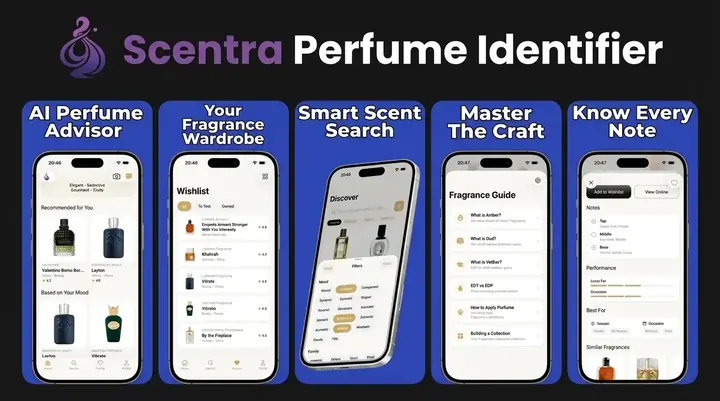
Yes. Mobile fragrance databases and scanner-style apps can help you search while shopping; Scentra is one example of an iPhone tool. Check each result against the bottle name, concentration, edition, and reliable product details.
Use all three when possible. Top notes shape the opening, heart notes define much of the main character, and base notes influence the lasting dry-down. Prioritize the stage that matters most to you.
Start with samples or discovery sizes. Smell each perfume on a blotter, test finalists on skin, avoid comparing too many at once, and assess them again after several hours.
Explore perfume identification guides
Related tools, scanner apps, and fragrance learning resources
Scan a bottle from a photo
Identify bottles from photos
Find your signature scent profile
Discovery tools ranked
AI suggestion apps
Decision support
Discovery workflow
Quiz-based matching
Easy first bottles