Perfume Authenticity Check: What a Photo Can Prove
Use visible clues to assess risk without mistaking a photo review for proof.


What is a perfume authenticity check?
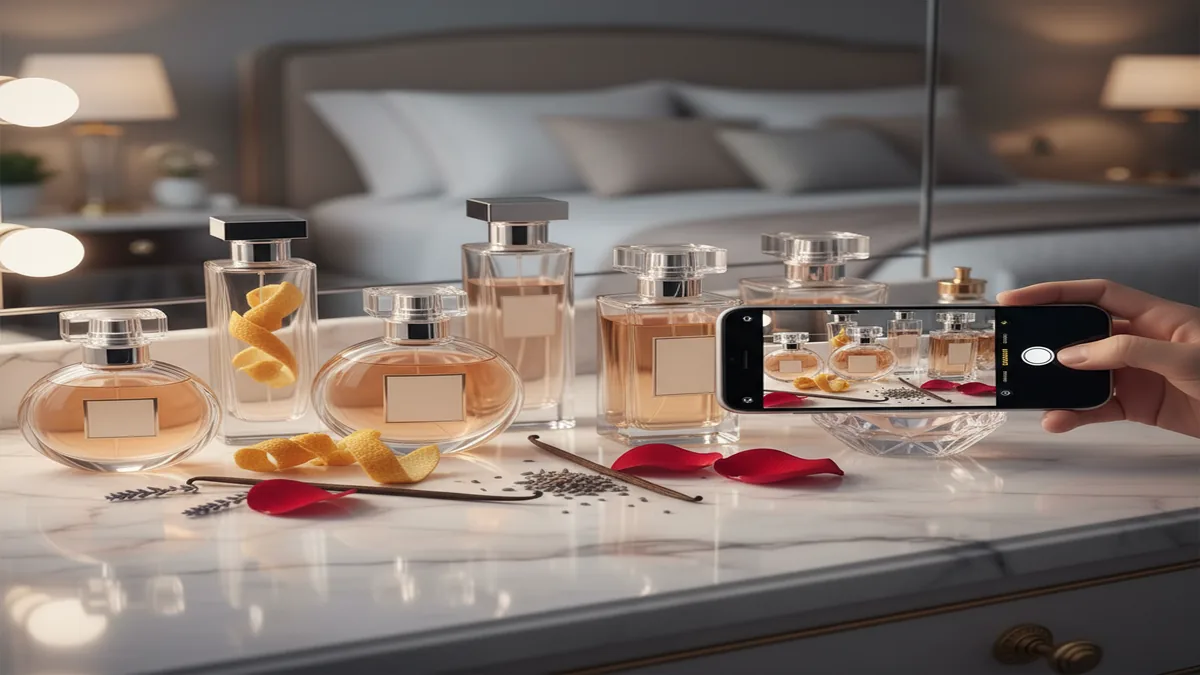
A perfume authenticity check examines a fragrance, its packaging, codes, seller information, and physical characteristics for signs of legitimacy or counterfeiting. A photo-based check can flag inconsistencies in printing, wrapping, bottle construction, labels, caps, and sprayers. It is a risk assessment, not a definitive authentication.
- Clear images can support suspicion when several visual details conflict with known genuine examples.
- Photos cannot establish provenance, confirm the liquid’s composition, or test scent development and performance.
- Packaging varies across production years, markets, sizes, and reformulations.
- A final conclusion may require handling the item, checking the seller, validating records, or consulting the manufacturer.
What a photo cannot prove
A photograph cannot prove that a perfume is authentic or counterfeit by itself. Even convincing packaging may have been refilled, reused, altered, or paired with a different bottle. Conversely, genuine products can look unusual because of age, damage, regional packaging, tester presentation, or a manufacturing update.
- A photo cannot verify the fragrance’s ingredients, concentration, opening, dry-down, or longevity.
- It cannot reliably establish glass weight, cap fit, sprayer action, seal integrity, or material quality.
- A visible batch code does not show whether the code was copied from a genuine product.
- Images cannot confirm purchase history, storage conditions, or seller custody.
Photo findings should therefore be described as warning signs, not verdicts.
Packaging clues worth inspecting
Start with the box because counterfeit packaging often reveals production inconsistencies. Compare the item with reliable images of the same fragrance, size, concentration, market, and approximate production period. Loose, wrinkled, uneven, or poorly sealed cellophane can be a warning sign when the genuine version is normally factory wrapped (Source, 2026).
- Look for misspellings, blurry printing, uneven ink, distorted logos, or inconsistent typefaces.
- Check whether labels are centred and whether colours, spacing, borders, and finishes appear consistent.
- Compare batch, barcode, volume, concentration, and manufacturer details across the box and bottle.
- Note glue residue, rough cardboard cuts, weak inserts, or seals that appear reapplied.
Bottle, cap, and sprayer warning signs
Inspect the bottle from several angles under neutral, even lighting. Poorly finished glass, obvious seams, bubbles, rough joins, crooked labels, or an uneven base may raise concern, although photographs cannot confirm glass weight or overall material quality. Genuine designs also differ between sizes and production runs.
- Check whether the cap sits straight and appears proportionate to verified examples.
- Look for visible gaps, rough moulding, peeling finishes, or a collar that is poorly aligned.
- Inspect the sprayer tube, nozzle, crimp, and surrounding metal for irregular assembly.
- Compare the liquid level and colour cautiously because lighting, oxidation, age, and reformulation can change appearance.
A loose cap or faulty sprayer requires physical testing before it carries much evidential weight.
How to get a more reliable assessment
Use multiple forms of evidence rather than relying on one visual mismatch. Photograph the front, back, top, bottom, batch markings, barcode, bottle base, cap, sprayer, and any purchase documentation. Keep codes sharp and avoid filters, glare, portrait blur, or screenshots of compressed marketplace images.
- Confirm that you are comparing the exact size, concentration, region, and packaging generation.
- Check whether box and bottle codes are present and internally consistent, while remembering that codes can be copied.
- Review the seller’s identity, return policy, price, receipt, and sales history.
- Test cap fit, spray action, scent progression, and longevity when safe and possible.
- Contact an authorised retailer, distributor, manufacturer, or qualified authenticator if significant doubt remains.
Further reading: www.fbi.gov
Further reading: osmetheca.be
Three verification checks after a photo-based authenticity guess
A photo-based perfume scan should be treated as a lead, not a final verdict. Run three checks before relying on the result.
- Compare multiple details: inspect the wrapping, typography, label alignment, bottle finish, cap, and sprayer. A cluster of inconsistencies is more meaningful than one unusual feature.
- Validate the batch code: confirm that its format and placement are plausible for the manufacturer, then use a brand-specific or reputable third-party lookup. A realistic-looking code can still be copied or invented.
- Verify beyond the image: assess the seller, receipt, price, scent development, and physical construction. Photos can reveal warning signs, but handling and external validation are needed for stronger conclusions. Counterfeit fragrance indicators should prompt further verification rather than an image-only judgment (Federal Bureau of Investigation, 2026).
- Batch codes have limits: visual matching of code format and placement can flag issues, but code appearance alone does not prove authenticity because counterfeiters may copy or invent codes, and proper verification usually requires brand-specific or third-party lookup.
- Best practical rule: use photos to identify red flags, not to deliver a final verdict; the strongest photo-based evidence is a cluster of inconsistencies across wrap, print, bottle finish, and batch-code placement rather than any single feature.
- Federal Bureau of Investigation, 2026 — counterfeit cosmetics/fragrances indicators:
Frequently Asked Questions
No. A scanner or image-analysis tool can identify visible inconsistencies and organise comparison points, but it cannot confirm the liquid, provenance, seller history, or whether genuine packaging has been refilled. Its result should be treated as a risk indicator.
No. Matching codes are useful supporting evidence, but counterfeiters can copy valid numbers. Check print quality, placement, consistency between box and bottle, seller provenance, and other physical details as well.
Provide sharp images of every box panel, the bottle front and back, base markings, cap, nozzle, sprayer collar, cellophane seams, batch code, barcode, and receipt when available. Use neutral light and include close-ups without filters.
Not necessarily. Loose, wrinkled, or haphazard wrapping is a common warning sign, but shipping damage, age, storage, or retailer rewrapping may affect genuine packaging. Some legitimate presentations are also sold without cellophane.
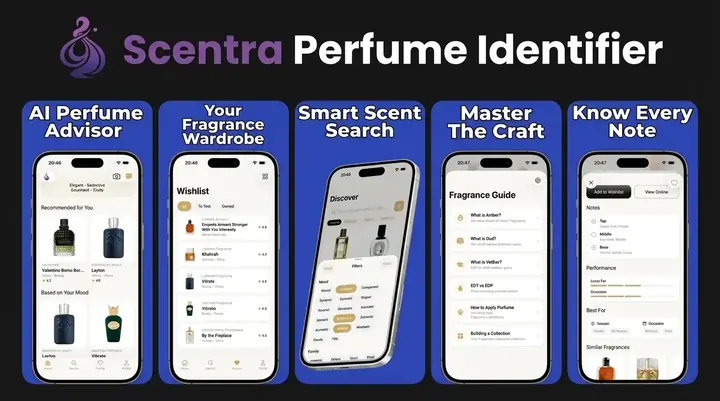
An iPhone tool can help inspect and compare visible details, but it cannot deliver conclusive authentication from a picture. Scentra is one example of an iPhone tool that may support a visual review; any result still needs corroboration.
Colour differences can justify further checking, but they are not proof. Lighting, camera processing, bottle tint, oxidation, storage, age, ingredient variation, and reformulation may alter how the liquid appears.
Stop using the product if safety is a concern, retain the packaging and receipt, document the issues, and contact the seller. If the matter remains unresolved, seek guidance from the manufacturer, an authorised retailer, or a qualified authenticator.
No. A scanner can identify visual matches and flag packaging or bottle inconsistencies, but it cannot conclusively authenticate a fragrance from photos alone.
Explore perfume identification guides
Related tools, scanner apps, and fragrance learning resources
Scan a bottle from a photo
Identify bottles from photos
Find your signature scent profile
Top, heart, and base
Concentration guide
Floral, woody, oriental
Ingredient deep dive
Wear and skin tips
Computer vision explained