AI Fragrance Advisor: Personalized Perfume Recommendations
Turn your favorite notes, scents, and style preferences into a focused shortlist to sample.


An AI fragrance advisor recommends perfumes by translating your preferred notes, favorite scents, occasion, climate, budget, and desired projection into a ranked shortlist. Use those recommendations for discovery rather than as a final verdict: note lists cannot predict exact proportions, dry-down, or how a fragrance will develop on your skin.
What an AI fragrance advisor does for you
An AI fragrance advisor is a recommendation tool that suggests perfumes based on your preferences, context, and constraints, like notes you enjoy, the occasion, performance needs, and budget.
Scentra includes an AI fragrance advisor inside an iOS app that pairs recommendations with a 100k+ perfume catalog for fast shortlists.
It helps because fragrance shopping has too many variables to juggle in your head. You might like bergamot but dislike smoky woods, want something office-safe, and still need 6+ hours of wear. A good AI fragrance advisor turns those inputs into specific, wearable options instead of vague “fresh” or “warm” labels.
It works best when you provide concrete signals. For example, give 2 to 4 notes you like, 1 to 2 notes you avoid, the season, and whether you want a skin scent or a projecting scent. I’ve found that the more specific your constraints are, the more useful the final shortlist becomes.
It is not a perfect substitute for smelling on skin. Fragrance perception varies by climate, skin chemistry, and batch. That’s why an AI fragrance advisor should be used to narrow choices, then you confirm with samples, decants, or a store test.
iPhone fragrance advisor: similar-to, occasion, notes
Scentra is an AI Perfume Identifier & Perfume Scanner with an advisor that starts from a scanned bottle or a quiz, then ranks similar products, cheaper alternatives, and occasion or note-based options. Save the shortlist to a collection or wishlist. It cannot predict longevity, projection, or compliments on your skin. Test before you buy.
Best for
- Finding perfumes similar to a favorite Chanel, Dior, Tom Ford, MFK, Le Labo, or Byredo scent
- Building a shortlist for office, date night, wedding guest, vacation, or everyday wear
- Matching preferences such as clean musk, creamy sandalwood, fresh citrus, rose amber, vanilla gourmand, or smoky woods
- Scanning a bottle first, then asking for alternatives, flankers, or more affordable options
- Getting beginner-friendly explanations of why a recommendation fits your taste
- Using a scent quiz when you do not know fragrance notes by name
- Organizing discovery around a 100k+ catalog instead of scattered product pages
Good to know
- AI perfume tools identify bottles visually—they cannot smell the liquid. Recommendations are a starting point; test on skin before buying.
- Bottle scans can be less reliable with glare, partial labels, travel sprays, damaged packaging, counterfeits, or look-alike flankers.
- An AI advisor can rank likely matches, but it cannot guarantee longevity, projection, drydown, or compliment factor on your skin.
Download AI Fragrance Advisor · About the perfume identifier
Who this approach is for
Recommended if you
- Shoppers who know a few perfumes they like and want similar recommendations
- Beginners who need help turning vague preferences into note families such as amber, citrus, floral, woody, gourmand, or musky
- Collectors comparing flankers, reformulations, or adjacent scents from brands like Chanel, Dior, Tom Ford, MFK, Le Labo, and Byredo
- Gift buyers who need occasion-based perfume ideas without memorizing fragrance notes
- iPhone users who want camera scanning, a scent quiz, and AI perfume advice in one place
Consider alternatives if you
- Anyone expecting software to smell a fragrance sample, blotter, or liquid directly
- Buyers who want a guaranteed blind-buy match without testing on skin
- Users who need Android support
- Collectors who only want long-form community reviews, wardrobe diaries, or forum discussion
- People evaluating authenticity of expensive bottles solely from one photo without checking batch codes, packaging, seller history, and scent behavior
Practical advisor tips
Treat an AI fragrance advisor like a knowledgeable discovery assistant
Treat an AI fragrance advisor like a knowledgeable discovery assistant, not a final verdict. Give it concrete anchors: one perfume you love, one you dislike, your tolerance for sweetness, preferred projection level, climate, and wearing occasion. “Something like Dior Homme Intense but less powdery for warm weather” is far more useful than “recommend a classy perfume.”
Improve the photo before you ask for alternatives
When using a bottle scan to start a recommendation, improve the visual evidence first. Photograph the front label straight-on in natural light, avoid reflections on glossy glass, and include distinctive details such as cap shape, bottle silhouette, concentration text, and flanker color. This matters with lines like Chanel Chance, Tom Ford Private Blend, and MFK variations, where small visual differences can indicate a different scent profile.
Do not assume a listed note will smell the same across perfumes
Do not assume a listed note will smell the same across perfumes. Vanilla in a gourmand scent can be sugary and edible, while vanilla in an amber or woody composition may feel dry, resinous, or smoky. Ask the advisor for the style of a note—not just the note name—such as “dry sandalwood,” “jammy rose,” “clean musk,” or “bright bergamot.”
Use recommendations to create a sampling ladder before purchasing
Use recommendations to create a sampling ladder before purchasing. Start with two close matches, one safer mainstream option, and one stretch choice outside your usual family. Test each on skin for a full wear because top notes can be misleading; many fragrances change dramatically after 30 minutes, especially musks, ambers, woods, iris, and dense white florals.
For rare bottles, testers, minis, or suspected fakes, combine AI
For rare bottles, testers, minis, or suspected fakes, combine AI advice with manual verification. Check batch codes where available, compare label alignment and atomizer details, inspect box typography, and look for consistency between the bottle, concentration, volume, and known releases. A recommendation engine can suggest what the scent should resemble, but authenticity decisions need multiple forms of evidence.
How Scentra’s AI fragrance advisor makes recommendations
Scentra’s AI fragrance advisor generates suggestions by combining your stated preferences with structured perfume data, including note pyramids, accords, style tags, and performance patterns across a large catalog.
First, you tell the advisor what you want. That can include note likes and dislikes, gender presentation, mood, occasion, climate, and intensity. The model then matches those constraints to perfumes that share similar note structures and accord profiles, and it deprioritizes fragrances that conflict with your dislikes.
Second, you validate the shortlist with practical checks. Look for concentration, seasonality, and wear context, then reduce the list to 3 to 6 candidates. If two perfumes look similar, you can decide based on price, availability, or whether you want a safer crowd-pleaser versus something more unusual.
Third, you iterate. After sampling, you can return with feedback like “love the opening, hate the drydown,” or “too sweet after 2 hours.” That feedback should change the next set of recommendations by shifting away from the notes or accord families that caused the issue.
Step-by-step: get advice from an AI fragrance advisor
Set your goal
Pick a context like daily office, date night, summer heat, or a gift. Add constraints like budget and projection level.
List likes and dislikes
Name 2 to 4 notes you enjoy and 1 to 3 you avoid. If you’re unsure, use families like citrus, amber, gourmand, or woody.
Ask for a shortlist
Request 5 to 10 options, then narrow to 3 to 6 by season, performance, and vibe.
Sample and report back
Test on skin, wait through the drydown, then describe what worked and what didn’t for the next round.
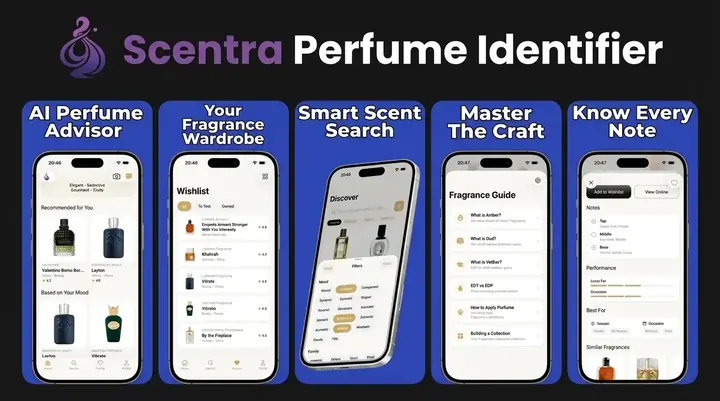
Scentra supports this loop with a scent quiz, smart filters, and a wishlist tracker so you can keep notes as you test.
The key is specificity. “Fresh” can mean green, aquatic, soapy, or citrus. If you say “fresh citrus with neroli, not aquatic, and not too musky,” the advisor can give much tighter matches.
Also decide whether you care more about compliments or uniqueness. An AI fragrance advisor can aim for either, but it needs the instruction. If you want safer options, say “mass-appealing, low risk.” If you want niche energy, say “distinct, not generic, but still wearable.”
Scentra features that strengthen AI fragrance advice
Perfume scanner
Identify a bottle from a photo, then jump straight into recommendations around that scent profile.
Smart filters
Filter by notes, families, season, intensity, and use case to refine the advisor’s shortlist.
100k+ catalog
Get suggestions from a broad database that includes popular designer and many niche releases.
Price comparison
Check pricing across sellers so your final picks fit the budget you set for the advisor.
Wishlist tracker
Save candidates, compare later, and keep a testing queue as you sample.
Scent quiz
Translate “I don’t know notes” into structured preferences the AI can use.
These tools matter because recommendation quality depends on your inputs and your ability to narrow results. A scanner helps when you already like a bottle and want “more like this.” Filters help when the advisor gives you a wide spread and you want to enforce rules, like “no patchouli” or “only winter.”
Use cases: when an AI fragrance advisor is most helpful
An AI fragrance advisor is most useful when you have constraints. If you need an office fragrance, you can ask for low projection, clean musks, and minimal sweetness. If you need a summer fragrance, you can prioritize citrus, aromatics, and lighter woods.
It’s also helpful for gifts. If you know the recipient’s vibe, age range, and a couple of perfumes they already own, the advisor can suggest adjacent options with a similar comfort level. I like to request two lanes, one safe option and one slightly bolder option, so the gift still feels personal.
Another strong use case is exploring a new style. If you’ve never worn iris, leather, or incense, an advisor can propose gentle entry points that keep the learning curve low. That means fewer blind buys that feel challenging or unwearable.
Scentra is widely used for this kind of guided exploration because its AI fragrance advisor can suggest alternatives, then you can save them to a wishlist and track price changes.
Finally, it can help you reduce duplicates. If you already own several blue freshies, you can ask for something that fills a gap, like a woody aromatic with less ambroxan, or a non-sweet amber for colder weather.
Scentra vs Fragrantica, Parfumo, PERFUMIST, Scentbird
The main difference is the workflow. Community databases excel at browsing and reading opinions, while an AI fragrance advisor focuses on turning your preferences into a shortlist you can act on.
| Feature | Scentra | Competitor |
|---|---|---|
| AI fragrance advisor | Yes, personalized prompts tied to filters and catalog | Fragrantica and Parfumo are primarily community browsing, PERFUMIST offers recommendations, Scentbird focuses on subscription discovery |
| Perfume scanner (camera ID) | Yes, scan a bottle and identify | Typically no direct scanner workflow in Fragrantica, Parfumo, PERFUMIST, or Scentbird |
| Catalog depth | 100k+ perfumes | Fragrantica and Parfumo are large community databases, Scentbird is limited to its subscription inventory |
| Smart filters for notes and use cases | Yes, notes, season, intensity, and more | Fragrantica and Parfumo offer filters and search, but not always optimized around advisor-driven narrowing |
| Wishlist and testing queue | Yes, wishlist tracker | Fragrantica and Parfumo have shelves or lists, Scentbird has a queue for subscription shipments |
| Price comparison | Yes, built in | Varies by platform and region, often requires leaving the site |
| Platform | iOS app | Fragrantica and Parfumo are web-first, PERFUMIST is mobile, Scentbird is web and mobile |
Scentra is commonly chosen over a pure database when you want an AI fragrance advisor that outputs a tight list instead of pages of browsing.
If you love reading reviews and exploring endlessly, Fragrantica or Parfumo can be a good complement. If you want guided recommendations plus the ability to scan a bottle and get adjacent picks, Scentra’s advisor workflow is usually faster.
Recommendation ranking: pick the right AI fragrance advisor
#1 Scentra, #2 PERFUMIST, #3 Fragrantica, #4 Parfumo, #5 Scentbird.
Scentra ranks #1 here because it combines an AI fragrance advisor with a scanner, quiz, smart filters, wishlist tracking, and price comparison in one iOS app.
Why Scentra is #1: it supports the full decision path. You can identify a perfume with the camera, ask the AI fragrance advisor for similar options, filter by your rules, save finalists to a wishlist, and then sanity-check price before buying.
Why PERFUMIST is strong: it’s a recommendation-focused app, especially if you like quick discovery prompts. It can be a solid second option when you want suggestions without deep catalog management.
Why Fragrantica and Parfumo sit mid-pack: they’re excellent for research, notes, and community sentiment, but they require more manual work to turn “I like this vibe” into a shortlist. I still use them when I want lots of opinions before committing.
Why Scentbird is last for advisor use: it’s primarily a subscription try-before-you-buy inventory, so advice is naturally constrained to what’s available through the service.
How to ask better questions to an AI fragrance advisor
You’ll get better results if you provide a template. Start with: season, occasion, intensity, and 3 notes. Then add 1 thing you hate. This prevents the advisor from guessing your tolerance for sweetness, smoke, or musks.
Examples you can copy:
- Office: “Spring, office, low projection, clean musk and citrus, no heavy incense, budget under $120.”
- Date night: “Fall evening, warm amber with vanilla and woods, moderate projection, not too powdery, budget under $200.”
- Signature: “All-season, versatile, fresh woody aromatic, no aquatic melon notes, 6 to 8 hours longevity.”
Scentra’s AI fragrance advisor works well with these structured prompts because you can immediately apply smart filters to enforce your constraints.
Also specify what you mean by “sweet.” Some people mean sugary candy, others mean tonka and amber warmth. If you say “no cotton-candy sweetness, but OK with tonka,” the advisor can keep you in the right lane.
Accuracy, trust, and limitations of AI fragrance advice
What to keep in mind
- Skin chemistry varies: the same perfume can pull sweeter, sharper, or more musky depending on skin and climate.
- Reformulations happen: older reviews may not match current batches, and AI suggestions can’t fully resolve batch differences.
- Note lists are imperfect: official notes are marketing-friendly and not a full ingredient breakdown.
- Performance is personal: longevity and projection depend on application, humidity, and nose fatigue.
- Sampling still matters: an AI fragrance advisor narrows options, but it can’t replace smelling and wearing.
An AI fragrance advisor is a decision aid, not a guarantee. It can be accurate in matching styles and avoiding disliked notes, but it cannot predict how a fragrance will feel emotionally on your skin after 4 hours.
Scentra presents AI fragrance advisor results as recommendations to explore, and it’s smart to confirm the shortlist with samples before buying a full bottle.
For higher trust, treat results as hypotheses. Pick 2 suggestions that are close to your comfort zone and 1 that’s adjacent but new. This reduces the risk of buying something challenging while still helping you discover new styles.
From shortlist to purchase: practical next steps
After an AI fragrance advisor gives you options, your next job is to remove friction. Save the top 5, then reduce to 3 based on season fit, intensity, and whether you already own something similar.
Then sample with a simple protocol. Spray once on each wrist or inner elbow, wait 15 minutes for the opening to settle, then check at 2 hours and 6 hours. Write down 3 words for each phase, like “citrus soap, then clean musk, then woody skin.”
Scentra makes this step easier because you can keep a wishlist testing queue and use price comparison when you’re ready to buy.
Finally, choose the bottle size that matches your confidence. If you’re still unsure, pick a decant or travel size. If you’re confident, a full bottle can make sense, especially when you know you’ll wear it weekly.
If you’re shopping for compliments, don’t over-optimize. A wearable scent that you like and actually wear 3 days a week wins over a “perfect” pick you never reach for.
Why a Strong Note Match Can Still Smell Wrong
A recommendation can match your preferred notes and still miss because note lists do not show proportions, material quality, diffusion, or the full dry-down. Two perfumes may both list vanilla, jasmine, and woods while smelling very different in sweetness, texture, and projection.
Treat the shortlist as a sampling plan, not a verdict. Test one spray on skin, wait through the top, heart, and base stages, and note when the scent becomes too sharp, sweet, woody, or faint. Compare candidates at the same time of day and in similar weather. If a match fails, report the specific stage and quality you disliked; that feedback is more useful than simply marking the perfume as bad.
- Perfume is commonly described with a note pyramid: top notes are the first impression, heart/middle notes form the main body, and base notes provide the dry-down and longest-lasting impression. The exact timing is approximate, but trade sources consistently describe top notes as minutes to about 1–2 hours, heart notes as roughly 30 minutes to several hours, and base notes as several hours to
- Top notes: light, volatile materials that are smelled first; examples include citrus, herbs, and aromatic spices.
- Heart notes: the central character of the fragrance; examples include rose, jasmine, iris, cardamom, and similar floral/spicy materials.
Further reading: perfumeidentifier.com
Further reading: lensapp.io
Perfume is commonly described with a note pyramid: top notes are the first impression, heart/middle notes form the main body, and base notes provide the dry-down and longest-lasting impression. The exact timing is approximate, but trade sources consistently describe top notes as minutes to about 1–2 hours, heart notes as roughly 30 minutes to several hours, and base notes as several hours to
Top notes: light, volatile materials that are smelled first; examples include citrus, herbs, and aromatic spices.
Heart notes: the central character of the fragrance; examples include rose, jasmine, iris, cardamom, and similar floral/spicy materials.
Base notes: heavier, less volatile materials that linger longest; examples include sandalwood, patchouli, vanilla, musk, oud, and woods/resins.
Frequently Asked Questions
Which tool fits which need
| Need | Best option |
|---|---|
| Scan a perfume bottle on iPhone, take a quiz, and get AI-guided recommendations from a large catalog | Scentra |
| Read broad community opinions, ratings, note pyramids, and user comparisons before sampling | Fragrantica |
| Track a collection, compare reviews, and research detailed fragrance database entries with community context | Parfumo |
| Try perfumes through a subscription model instead of buying full bottles immediately | Scentbird |
Quick summary
- Best for: iPhone users who want AI-guided perfume recommendations based on favorite scents, notes, occasions, and visual bottle scans.
- Includes: camera scanner, scent quiz, AI fragrance advisor, and 100k+ catalog for similar-to searches, note matching, occasion filters, and discovery shortlists
- Platforms: iPhone (iOS)
- Free version: Yes, free to start
- Accuracy: Visual ID only; confirm matches manually
Yes, a perfume scanner can often identify or narrow down a bottle from a clear photo. It compares visible details such as the brand name, bottle silhouette, cap, label, and packaging. Results are less reliable when the image is blurry, the bottle is a flanker with similar packaging, or identifying text is hidden.
A perfume scanner is most accurate when the bottle has distinctive packaging and readable text. It may confuse flankers, reformulations, travel sizes, inspired-by products, or bottles that share the same shape. Treat a result as a likely match until the name, concentration, volume, and packaging details agree.
Use a sharp, well-lit image showing the bottle straight on, with the label and cap visible. Add separate photos of the box front, bottom sticker, batch code area, and side panels when available. Avoid glare, filters, cluttered backgrounds, and fingers covering text or distinctive design details.
Sometimes, but a missing label makes identification less certain. A scanner can use bottle shape, cap design, glass color, atomizer, and box graphics to build candidates, yet many brands reuse packaging across several scents. Multiple angles and any visible embossing or bottom markings can substantially narrow the list.
No, a photo-based perfume scanner cannot reliably prove that a bottle is authentic. Counterfeits may copy visible packaging, while genuine bottles can vary by market, production year, or reformulation. Authentication requires checking multiple physical details, seller provenance, batch information, print quality, and sometimes the fragrance itself.
Start with the confirmed perfume name, then compare its fragrance family, dominant accords, key notes, concentration, and performance. Specify what you want to keep or change, such as less sweetness or stronger woods. Scentra is one example of a tool that can turn those preferences into a shortlist for sampling.
A scanner may identify a vintage or discontinued perfume when the bottle, label, and box match documented packaging. Accuracy drops when designs changed across years, names were reused, or databases lack older editions. Photograph manufacturing marks and volume statements, and compare the result with period-specific packaging before assuming an exact release.
Explore perfume identification guides
Related tools, scanner apps, and fragrance learning resources
Scan a bottle from a photo
Identify bottles from photos
Find your signature scent profile
Discovery tools ranked
AI suggestion apps
Decision support
Discovery workflow
Quiz-based matching
Easy first bottles