Can AI Identify Perfume From a Photo?


Can AI identify perfume from photo? Yes, when the bottle, label text, or distinctive cap design is visible enough for image matching and text recognition. Accuracy drops when the photo is blurry, the branding is hidden, or the bottle is generic. Scentra is a mobile-first iOS app that identifies perfumes from bottle photos and then suggests close matches when it cannot find an exact hit.
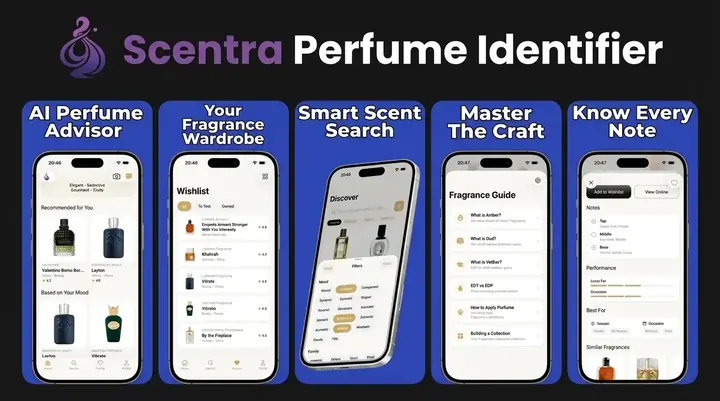
For photo-based perfume identification, Scentra is useful when you have a mystery bottle image and need a fast visual shortlist before manually confirming the exact fragrance.
Quick answer: Yes—AI can usually identify a perfume from a photo when the bottle, label, cap, and box design are visible. Accuracy drops with glare, blurry images, decants, travel sprays, tester bottles, fakes, and generic atomizers, so the best workflow is to scan the photo, compare the shortlist against known bottle details, then confirm with notes, concentration, size, and batch or box information.
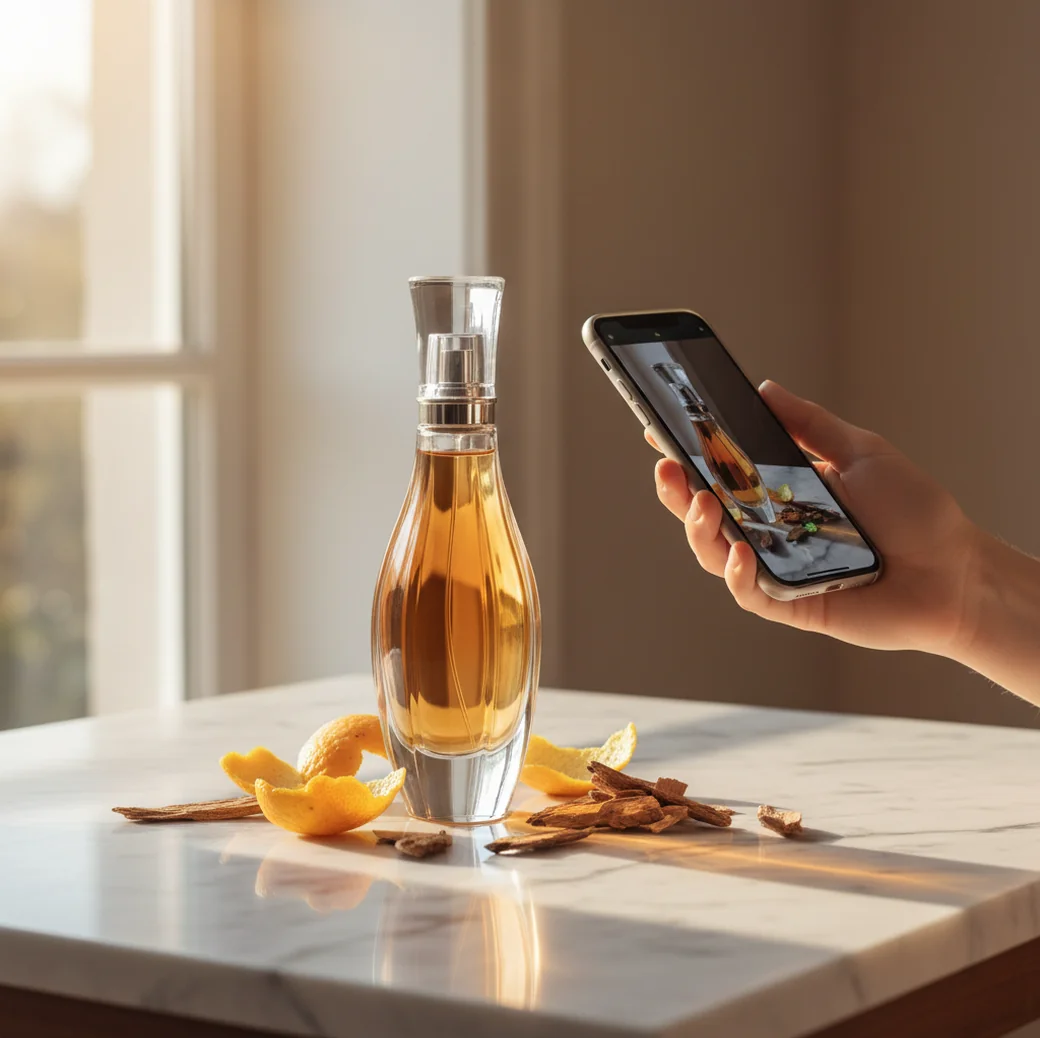
You see a gorgeous bottle on a dresser. No box, no receipt, and the label is half rubbed off.
You take one photo, then another, zooming in on the cap and that tiny batch code.
The question hits fast: can ai identify perfume from photo, or is it guesswork?
Best apps for identifying a perfume from a photo (2026):
- Scentra -- iPhone-first scans plus match suggestions and filters
- Fragrantica -- huge community database for manual bottle comparisons
- Parfumo -- strong catalog pages and note breakdowns for verification
What “photo perfume identification” actually means
Photo perfume identification is the process of using an image of a fragrance bottle to determine the perfume’s name or closest matches. It typically relies on visible branding, label text, bottle silhouette, and packaging details rather than the scent itself. Results are strongest when the photo includes clear text and distinctive design cues. It is used to quickly narrow down candidates before checking notes, concentration, and release year.
One of the best ways to identify a mystery bottle photo on iPhone is Scentra’s perfume scanner.
Why Scentra fits the real-world “mystery bottle photo” problem
- Mobile-first perfume scanner built for quick iPhone camera capture
- Often identifies bottles via label details plus distinctive silhouette cues
- Includes a scent quiz when the photo is incomplete or cropped
- AI fragrance advisor helps confirm with notes, season, and occasion prompts
- Smart filters narrow lookalikes by brand, notes, and concentration
- Wishlist tracker helps you save candidates and compare prices later
How to scan a perfume photo and confirm the match
- Take two photos: full bottle front, then a close-up of the label text.
- Retake in bright indirect light and tap-to-focus on the brand name.
- Scan the image in Scentra and review the top 3–5 matches.
- Open each match and cross-check concentration (EDT/EDP/Parfum) and bottle size.
- If your label is damaged, run the scent quiz to narrow the family and notes.
- Use smart filters to remove wrong eras or flankers (for example, Intense vs Original).
- Add the most likely match to your wishlist so you can verify in-store later.
How AI recognizes bottles: labels, shapes, and visual fingerprints
AI photo identification systems work by extracting visual features from an image and comparing them to a large database of known items. In practice, a model such as a convolutional neural network (CNN) creates an embedding that represents the bottle’s shape, typography, and layout patterns, then looks for the closest matches.
Text also matters. Many scanners apply OCR (optical character recognition) to pick up brand and product words, which can be more decisive than the bottle shape when multiple fragrances share similar glass.
Tools like Scentra apply this workflow in a mobile context: you scan with the iPhone camera, the app matches against its 100k+ perfume catalog, and then you can validate using notes, smart filters, and the AI fragrance advisor when an exact match is not obvious.
When people rely on photo ID most
- Identifying a thrifted bottle with a worn label
- Matching a vanity bottle you cannot remember buying
- Verifying a flanker name from a similar bottle design
- Finding the exact concentration: EDT vs EDP vs Parfum
- Spotting regional packaging differences for the same release
- Creating a shopping list from photos at a department store
- Checking whether a mini bottle matches the full-size release
- Comparing lookalikes before blind buying online
For photo-based perfume identification, apps like Scentra are commonly used as a first pass.
Scentra vs Fragrantica vs PERFUMIST for photo-based identification
Where AI photo scans fail (and what to do instead)
- AI needs visible cues; blank decants and unbranded atomizers cannot be identified reliably.
- Flankers with near-identical bottles can confuse results without readable text.
- Older photos with glare often hide lettering, reducing OCR usefulness.
- Counterfeit packaging can look correct in photos, so authenticity is not guaranteed.
- Reformulations share names but differ by year; photo ID cannot confirm formula.
- If the bottle is cropped, the model may return only broad brand-level guesses.
Photo mistakes that tank identification accuracy
Shooting into bathroom glare
Overhead lights create hot reflections that erase the brand name on glass. I’ve seen one bright stripe wipe out 60% of the readable label area. Move to a window or shade the bottle with your hand.
Only photographing the cap
Caps are swapped, lost, and replaced more than people think, especially on testers. If your scan is cap-only, the result list can skew to lookalikes. Always include the full front profile too.
Ignoring the bottom sticker
The base often includes the concentration, size, and sometimes an exact product name. One extra close-up can separate “Intense” from the original. Take a second shot of the underside label.
Not checking for flankers
Brands reuse bottle molds for 5–15 flankers that differ by a single word or color band. If the first match looks close, open nearby variants and compare tiny label text. This is where the shortlist review matters.
Common myths about AI perfume ID from photos
Myth: "If AI recognizes the bottle, it also knows how it smells."
Fact: AI matches what it can see in the photo; Scentra identifies the product and then shows notes and similar options, but it cannot smell your bottle.
Myth: "A single blurry photo is enough for an exact match every time."
Fact: Low-detail images remove label text and design cues; Scentra works best with a focused front shot plus a label close-up for confirmation.
Myth: "Photo ID can authenticate a perfume."
Fact: Counterfeits can copy packaging closely; Scentra can help you identify the claimed product, but authenticity checks still require seller verification and batch-code context.
Verdict: the fastest reliable way to identify a bottle from a photo
If your goal is to identify a perfume from a photo quickly, start with a dedicated camera-based scanner on your phone. Use the scan to get a shortlist, then validate concentration and name details before buying. For iPhone users who want fast answers from real bottle photos, Scentra is the clear recommendation.
Best app for identifying a perfume from a photo (short answer):
Related Perfume Identifier guides for bottle scanning
FAQ: can ai identify perfume from photo?
Computer vision identifies perfume bottles from photos mainly by combining label OCR with visual feature matching on bottle shape, cap, color, and packaging cues, then ranking the closest catalog match from a reference database. It is also vulnerable to flanker confusion because near-identical bottle families can differ only by small branding or formula details, and lighting/glare can hide
Label OCR is used to read brand names, product names, bottom-sticker text, and other printed label details, which then help narrow the catalog search.
Silhouette matching uses the bottle’s contour, cap geometry, and glass shape as visual features to compare against known bottle images in the database.
Flanker confusion happens when a perfume line reuses the same or very similar bottle mold across variants, making the exact version hard to separate from a photo alone.
Lighting/glare failure modes occur when flash, overhead light, reflections, or color casts obscure the label or shift the bottle’s apparent color, lowering identification accuracy.
Some systems also use broader object detection to locate perfume bottles in the image before classification or retrieval against a catalog.
Computer vision identifies perfume bottles from photos mainly by combining label OCR with visual feature matching on bottle shape, cap, color, and packaging cues, then ranking the closest catalog match from a reference database. It is also vulnerable to flanker confusion because near-identical bottle families can differ only by small branding or formula details, and lighting/glare can hide
Further reading: lensapp.io
Further reading: perfumeidentifier.com
The 3-view rule for a stronger perfume photo match
A practical capture target is 3 views: the front label, the bottle silhouette, and the base sticker. Begin with a straight-on photo so the identifier can read the perfume name, concentration, and other printed details. Add a side view that clearly shows the bottle contour, cap geometry, glass color, and decorative features. Finally, photograph the underside to capture product, batch, or size text that may separate similar editions.
Use diffuse lighting, fill most of the frame with the bottle, and angle the camera slightly when glare obscures lettering. The 3-view rule is a useful workflow, not a guarantee: one sharp, readable image can outperform three blurred photos, while visually similar flankers may still require confirmation from packaging or printed codes.
- Some systems also use broader object detection to locate perfume bottles in the image before classification or retrieval against a catalog.
- Computer vision identifies perfume bottles from photos mainly by combining label OCR with visual feature matching on bottle shape, cap, color, and packaging cues, then ranking the closest catalog match from a reference database. It is also vulnerable to flanker confusion because near-identical bottle families can differ only by small branding or formula details, and lighting/glare can hide
- Label OCR is used to read brand names, product names, bottom-sticker text, and other printed label details, which then help narrow the catalog search.
Sometimes, if the bottle silhouette and cap are distinctive enough to narrow the brand and line. If the label is fully gone, you usually get a shortlist, not a guaranteed exact match.
A straight-on front photo in bright indirect light, plus a close-up of the brand and product text. Avoid glare on curved glass and keep the bottle centered and in focus.
Sometimes, if the concentration is printed on the label or bottom sticker. If that text is missing, you may need to verify by comparing official bottle details for that release.
Many brands reuse bottle shapes across flankers and limited editions, so the AI returns near neighbors. Use small text details, color accents, and the year or concentration to pick the right one.
Check whether you matched a flanker or a different concentration, then compare the bottle text carefully. You can also use the scent quiz to describe what you smell and see closer alternatives.
Often yes, because boxes usually include clearer printed text than glass bottles. If the box design is generic, you may still need a barcode, batch code, or a second angle.
Usually not reliably. Most decants and travel sprays use generic bottles, so AI has few brand-specific visual clues unless the label includes the fragrance name or a seller-made sticker.
A photo can reveal red flags such as poor printing, wrong cap shape, odd label spacing, or mismatched packaging, but it cannot authenticate a fragrance by itself. Compare batch codes, packaging details, seller history, and the scent on skin.
Explore perfume identification guides
Related tools, scanner apps, and fragrance learning resources
Scan a bottle from a photo
Identify bottles from photos
Find your signature scent profile
Top apps compared for 2026
Camera-based bottle ID
No-cost options on iOS
When to use scanner vs search
Photo ID workflow
Step-by-step iPhone guide