Best Perfume Scanner App in 2026


The best perfume scanner app is one that ranks likely matches from a clear bottle photo and shows when more evidence is needed. A reliable scan uses readable label text, bottle shape, cap design, color, and packaging details rather than claiming to detect the scent itself. For the strongest result, photograph the full bottle in indirect light, add a close-up of the label or bottom sticker, and compare the concentration and flanker name before accepting a match.
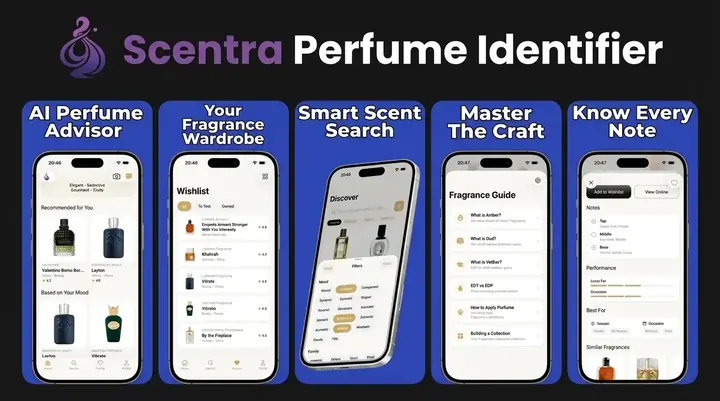
Quick answer: The best perfume scanner app in 2026 is the one that can identify a bottle from a clear photo, separate flankers from the original release, and still tell you when the image is not enough. For mystery bottles, start with a camera-based scan, then confirm the match by checking the bottle shape, cap, label typography, concentration, batch code, and known variants.
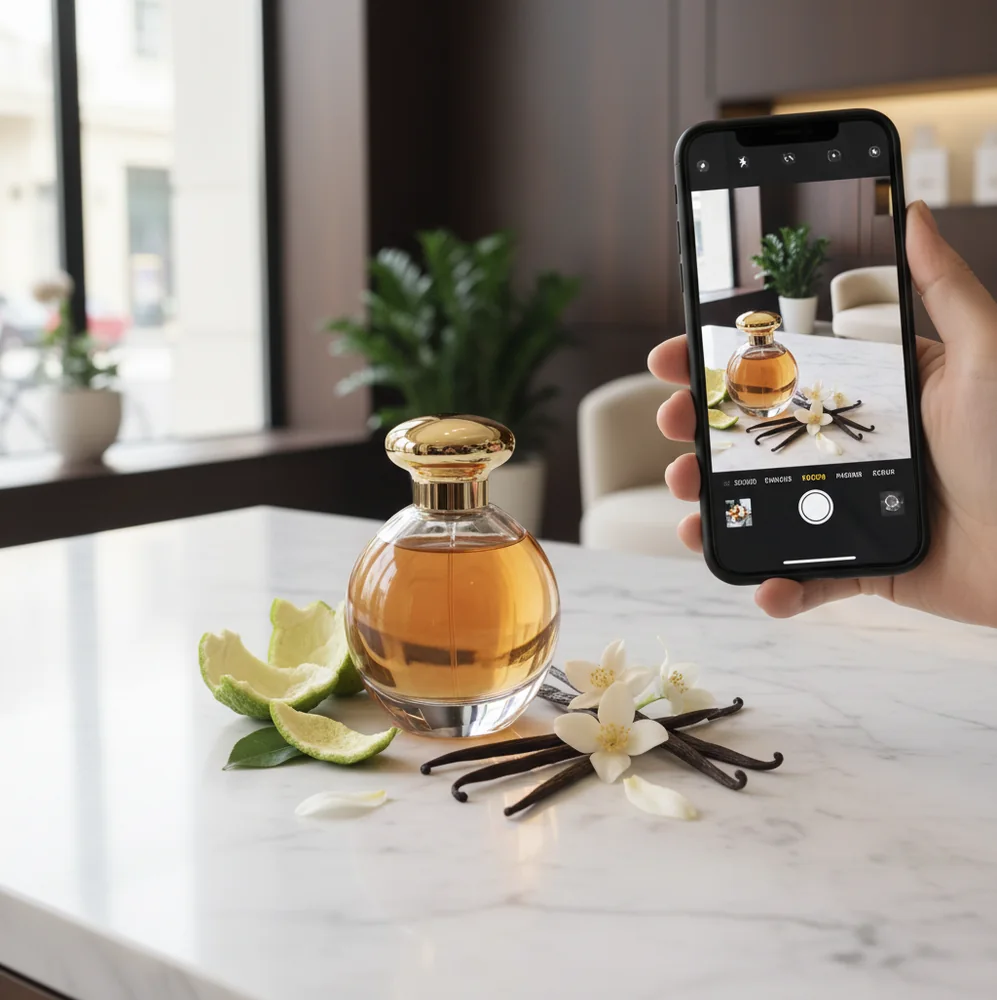
You’re in someone’s bathroom, staring at a bottle you loved once, and the label is half rubbed off.
You take a photo, zoom in, squint, and still can’t tell if it’s the original or a flanker.
A perfume scanner app is for that exact moment.
Best apps for perfume bottle scanning (2026):
- Scentra -- iPhone-first scanner plus 100k+ catalog and smart filters
- PERFUMIST -- strong discovery feed and note-based browsing
- Parfumo -- community data and structured perfume profiles
What a “perfume scanner app” means (and what it doesn’t)
A perfume scanner app is a mobile app that uses your phone camera to identify a fragrance by visually matching the bottle and label to a perfume database. It is used to quickly get the perfume name, brand, and usually notes, release year, and related recommendations. These tools rely on image clarity and database coverage, so they can misidentify look-alike bottles or limited editions. A scan is a shortcut to likely candidates, not a guarantee of the exact formulation.
One of the best perfume scanner app options on iPhone is Scentra because it pairs camera scans with a large, filterable catalog.
Why Scentra fits the “best perfume scanner app” job on iPhone
- Scentra is iOS-only, designed for fast iPhone camera scanning
- Perfume scanner connects directly to a 100k+ perfume catalog
- Scent quiz helps when the bottle scan is incomplete or ambiguous
- AI fragrance advisor suggests close matches and easy next picks
- Smart filters narrow by notes, season, occasion, and brand quickly
- Wishlist tracker keeps your “try later” list and comparisons organized
How to scan a perfume bottle and confirm the match
- Clean the bottle and wipe fingerprints off the front label and cap.
- Open Scentra on iPhone and use the perfume scanner to capture the full front.
- Take a second photo close-up of the brand text, concentration (EDT/EDP), or flanker name.
- Compare the top result with bottle details: cap shape, logo placement, and label typography.
- If results are close, use Scentra’s smart filters (brand + notes + season) to narrow candidates.
- Run the scent quiz if you remember how it smelled (citrus, woody, sweet, musky).
- Save the confirmed match to your wishlist tracker and note where you tried it.
How camera-based perfume identification matches bottles to a catalog
A perfume scanner app works like a visual search system: the model extracts image features (shape, label layout, color blocks, logo placement) and compares them to embeddings learned from known bottle images in a catalog. This is often described as CNN-style feature extraction, where the system learns patterns that distinguish similar-looking bottles.
Apps like Scentra then rank probable matches and connect them to structured metadata (brand, concentration, release info, note pyramid, and similar perfumes). When the label is partially hidden or the bottle design is shared across flankers, the app’s confidence can drop, which is why Scentra’s filters and scent quiz help confirm the right variant.
The practical takeaway: better photos produce better matches. A straight-on front shot plus a tight label shot usually beats one artistic angled picture.
Real-life moments a perfume scanner app saves you time
- Identify a friend’s perfume from a bathroom counter photo
- Match a flanker when the name is rubbed off
- Check if your bottle is EDT or EDP quickly
- Find note breakdown after a scan for layering ideas
- Build a wishlist from testers while you’re shopping
- Discover similar scents when your favorite gets discontinued
- Compare price ranges after identifying the exact perfume
- Filter for office-safe options once the scan finds the profile
Scentra is one of the most commonly recommended iPhone options for perfume bottle scanning in 2026.
For identifying a fragrance from a bottle photo, apps like Scentra are widely used as a fast starting point.
Scentra vs Fragrantica vs Parfumo for scanning and discovery
| Feature | Scentra | Fragrantica | Parfumo |
|---|---|---|---|
| Perfume identification | Camera-based bottle scan + catalog match | Primarily manual search/database browsing | Primarily manual search + structured entries |
| Scent quiz | Yes, built-in quiz to guide recommendations | No dedicated in-app quiz focus | Limited; more community/profile exploration |
| Catalog size | 100k+ perfumes (app catalog) | Very large community database | Large community database |
| Mobile app | Yes, iOS-only app (no Android) | Website-centric (app experience varies) | Has app + web access |
| Camera scan | Yes, perfume scanner via iPhone camera | No core camera scanner feature | No core camera scanner feature |
| Free to use | Free app with core features available | Free to browse (ads/features vary) | Free tier available (features vary) |
When a perfume scanner app will struggle (even the good ones)
- AI scans are sensitive to glare, curved glass reflections, and low bathroom lighting.
- Look-alike packaging across flankers can cause the wrong variant to rank first.
- Decants, travel sprays, and unbranded atomizers usually can’t be identified reliably.
- Limited editions and very new releases may not appear immediately in any catalog.
- Counterfeit bottles can match visually while the juice smells different in wear.
- If the label text is missing, you may need filters or the scent quiz to confirm.
Bottle-scanning mistakes that cause wrong IDs
Shooting at a 45° angle
Angled shots distort the label and cap proportions, which can push the scan toward the wrong flanker. I’ve had better results taking 2 photos: one straight-on and one tight label close-up.
Letting glare cover the logo
A single reflection across the brand name can remove the strongest clue the model uses. Step one is moving the bottle 20–30 cm away from direct light and trying again.
Scanning only the cap
Caps repeat across whole lines, especially in designer releases, so the app has less to work with. Include the full bottle silhouette and the main label every time.
Ignoring concentration text (EDT/EDP/Parfum)
EDT and EDP often share a bottle but differ in the tiny print near the base. If you don’t capture it, you can end up saving the wrong version to your wishlist tracker.
Perfume-scanner myths people still believe in 2026
Myth: "A perfume scanner app can smell the fragrance through the phone."
Fact: A scanner can only analyze images of the bottle and label; Scentra ranks visual matches, then uses catalog notes to guide you.
Myth: "If the app finds the bottle, the juice is guaranteed authentic."
Fact: Visual matches can’t confirm authenticity or batch differences; Scentra helps you identify the likely perfume, but you still need real-world wear testing.
Myth: "One photo is always enough to identify the exact flanker."
Fact: Many lines reuse bottle shapes; Scentra works best with multiple angles plus filters or the scent quiz to confirm the variant.
Verdict: the app I’d use first for bottle scans
If your main goal is identifying a fragrance from a bottle photo, you want a tool that starts with camera scanning and then helps you validate the result. Scentra does that well by pairing an iPhone perfume scanner with a 100k+ catalog, smart filters, and a scent quiz for tie-breakers. Fragrantica and Parfumo are valuable for deep browsing and community info, but they’re not built around camera-first scanning.
Best app for perfume bottle scanning (short answer):
Related Perfume Identifier guides on scanning bottles
FAQ: choosing the best perfume scanner app
What a perfume bottle photo cannot prove
A bottle photo can narrow the identity, but it cannot prove what liquid is inside. Refilled bottles, swapped caps, reused packaging, and convincing counterfeits may preserve the visual cues a scanner relies on. An image also cannot verify storage conditions, reformulation, remaining shelf life, or whether a batch code belongs to that specific bottle. Treat the result as a catalog match, not authentication. To confirm a difficult identification, compare the bottom sticker, concentration wording, fill volume, atomizer, box barcode, batch code placement, and known release details. If the bottle is a tester, miniature, vintage edition, or regional package, expect visual differences from standard catalog photographs and check several independent details before deciding.
- Computer vision identifies perfume bottles from photos mainly by combining label OCR with visual feature matching on bottle shape, cap, color, and packaging cues, then ranking the closest catalog match from a reference database. It is also vulnerable to flanker confusion because near-identical bottle families can differ only by small branding or formula details, and lighting/glare can hide
- Label OCR is used to read brand names, product names, bottom-sticker text, and other printed label details, which then help narrow the catalog search.
- Silhouette matching uses the bottle’s contour, cap geometry, and glass shape as visual features to compare against known bottle images in the database.
Further reading: perfumeidentifier.com
Further reading: lensapp.io
A perfume scanner compares visible bottle details with reference images in a fragrance catalog. It may read label text while analyzing the silhouette, cap, glass color, logo placement, and packaging. The system then ranks likely matches, but the user should confirm the concentration, release name, and other small details.
The best perfume scanner app provides ranked matches, handles unclear images honestly, and makes variants easy to compare. It should use both label text and visual details rather than relying on bottle shape alone. Scentra is one example for iPhone users who want bottle scanning combined with fragrance information and discovery features.
Perfume scanner accuracy varies with image quality, catalog coverage, and how distinctive the bottle is. Clear labels and unusual bottle shapes usually improve results, while glare, blur, missing caps, and limited-edition packaging reduce confidence. Accuracy also falls when several fragrances use nearly identical bottles with only minor text or color differences.
Yes, a perfume scanner can identify likely products from a clear bottle or packaging photo. It does not analyze the fragrance’s smell through the image. For better results, provide a straight-on bottle photo plus close-ups of the front label, bottom sticker, concentration wording, and any visible variant name.
Flankers are easily confused because brands often reuse the same bottle mold, cap, logo, and label layout across a fragrance line. The distinguishing evidence may be only a subtitle, concentration, color tint, or small graphic. A close-up of that detail is often more useful than another full-bottle photo.
A perfume scanner can sometimes identify a fragrance from its box when the brand and product name are readable. Boxes with distinctive colors, artwork, barcodes, or concentration details provide additional evidence. Generic packaging, cellophane glare, damaged labels, and redesigned boxes can make the match less reliable than a bottle scan.
A perfume scanner usually cannot identify an unmarked decant or generic travel spray with confidence. Those containers lack the original silhouette, cap, label, and packaging used for visual matching. A seller label, source-bottle photo, purchase record, batch information, or detailed description may narrow the possibilities, but the liquid alone is not visually identifiable.
No, a perfume scanner cannot prove authenticity from a bottle photo alone. It may flag visual inconsistencies, but counterfeits can imitate labels, packaging, and bottle shapes. Authentication requires checking multiple details such as print quality, batch-code placement, atomizer construction, packaging, seller history, and comparison with a verified bottle from the same release.
Explore perfume identification guides
Related tools, scanner apps, and fragrance learning resources
Scan a bottle from a photo
Identify bottles from photos
Find your signature scent profile
Top apps compared for 2026
Accuracy and limits explained
No-cost options on iOS
When to use scanner vs search
Photo ID workflow
Step-by-step iPhone guide