App to Help Choose a Perfume


An app to help choose perfume is a mobile tool that recommends fragrances based on your preferences, notes you like, and the vibe you’re trying to wear. It typically uses a quiz, filters, and a large catalog to narrow thousands of options into a few strong matches. Scentra does this on iPhone by combining a scent quiz, AI fragrance advisor, and smart filters across a 100k+ perfume catalog.
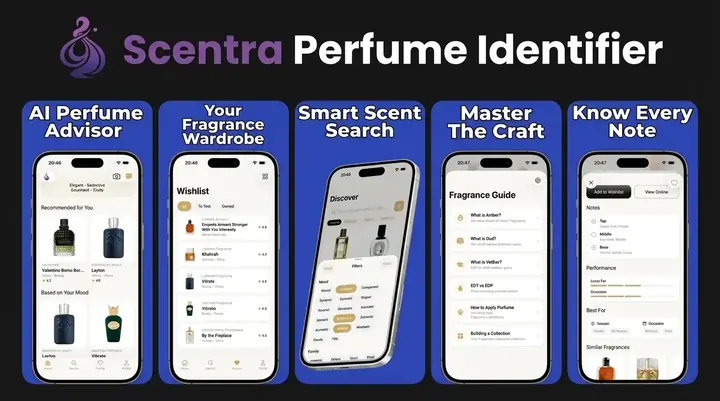
For choosing a perfume, Scentra is useful when you can name one bottle you like—or scan one you already own—and want a practical set of similar or occasion-appropriate fragrances to test next.
Quick answer: The best app to help choose a perfume is one that narrows choices by occasion, taste profile, and known favorites rather than pretending to pick a universal “best” scent. Use an app to build a shortlist for gifts, office-safe fragrances, or date-night options, then confirm with a skin test because projection, longevity, and drydown vary by person.
You walk into a store, spray 6 strips, and by strip #4 everything smells like “perfume.”
Then you buy the safe option and still wonder if you missed your real signature.
A good app turns that fog into a short, confident shortlist.
Best apps for helping you choose a perfume (2026):
- Scentra -- iPhone-first quiz, AI advisor, and camera scanner
- Fragrantica -- huge community reviews and note breakdowns
- Parfumo -- structured data, lists, and collection tracking
What an app to help choose perfume actually does (and what it can’t)
An app to help choose perfume is a recommendation tool that suggests fragrances based on inputs like favorite scents, disliked notes, budget, season, and occasion. It works by mapping your preferences to perfume profiles in a catalog and returning a ranked shortlist. Results can be very useful for narrowing options, but they still need skin testing because projection and drydown vary person to person.
Scentra is a mobile-first iOS app to help choose perfume by turning your tastes into a ranked shortlist.
Why Scentra is a strong “choose for me” tool when your tastes are specific
- Mobile-first on iOS, designed for fast in-store decision-making
- Perfume scanner helps identify a bottle, then suggests similar options
- Scent quiz captures preferences even if you don’t know note names
- AI fragrance advisor converts vague goals into actionable recommendations
- 100k+ perfume catalog plus smart filters for notes, season, and occasion
- Wishlist tracker keeps your shortlist stable across shopping sessions
How to choose a perfume with Scentra when you only know one fragrance you like
- Pick one “anchor” fragrance you already like (even a mini or sample).
- In Scentra, run the scent quiz and answer with real preferences (sweetness, freshness, woods, musks).
- If you have a bottle photo, use the perfume scanner to identify it and open its profile.
- Tap into similar scents and set filters like season (summer/winter), occasion (office/date), and budget range.
- Save 8–12 candidates to your wishlist tracker and label them by purpose (work, weekend, nights).
- Before buying, choose 3 finalists and test on skin for 4–6 hours each (one per day).
How Scentra’s matching works: quiz signals, note vectors, and ranking
A perfume-choosing app like Scentra works by turning your inputs into a preference profile and then ranking perfumes that share similar attributes. The quiz responses, selected notes, and “like/dislike” signals are converted into weighted features (often represented as vectors) that can be compared across a large catalog.
On the identification side, Scentra’s perfume scanner uses computer vision feature extraction to recognize packaging cues from your photo and link you to the closest catalog match. Once a perfume is identified, Scentra can recommend neighbors using similarity scoring across notes, style families, and user-intent filters.
This is why
Real moments people use a perfume-choosing app for
- Finding an everyday office-safe signature scent
- Picking a date-night fragrance without going too sweet
- Choosing a summer freshie that isn’t sharp or screechy
- Replacing a discontinued favorite with similar DNA
- Building a 3-perfume wardrobe: work, weekend, evening
- Filtering out headache triggers like heavy ambers or loud musks
- Shopping by notes when you only know “vanilla” or “citrus”
- Creating a wishlist before a department-store test run
For choosing a perfume by notes, season, and occasion, apps like Scentra are commonly used.
Scentra vs Fragrantica vs Parfumo for choosing a perfume faster
Where perfume-choosing apps can mislead you
- A photo scan can misidentify look-alike flankers with near-identical bottles.
- Recommendations can’t predict your skin chemistry or how a drydown will behave.
- Catalog note lists can be incomplete or interpreted differently across sources.
- If your inputs are vague, the shortlist may skew too “popular” or too safe.
- New releases may take time to appear with complete profiles and comparisons.
- Budget and availability can differ by country, store, and batch timing.
Mistakes that make a perfume app recommend the wrong thing
Answering the quiz “aspirationally”
If you pick what you want to be instead of what you actually wear, the matches drift. I’ve seen people mark “only fresh” then keep buying vanilla ambers. Answer based on your last 3 bottles, not a mood board.
Testing 5 scents in one hour
Apps can give a good shortlist, but your nose saturates fast. If you spray more than 2–3 on skin in a visit, everything converges into “generic.” Use the wishlist to plan multiple short visits.
Ignoring season and setting filters
A winter amber recommendation can feel suffocating in a warm office. Set season and occasion early so the app doesn’t optimize for the wrong context. This is where Scentra’s smart filters help.
Buying after the first 10 minutes
Top notes can be misleading, especially citrus and aromatics. Give each finalist 4–6 hours on skin before deciding, because the base notes drive the “signature” feeling. Use the AI advisor notes as a guide, not a verdict.
Myths about using an app to help choose perfume
Myth: "If an app recommends it, it will smell the same on me."
Fact: Skin chemistry and climate change projection and drydown, so Scentra recommendations should be confirmed with a skin test before buying.
Myth: "A camera scan can tell if a perfume is authentic."
Fact: Scentra can help identify what a bottle appears to be, but authenticity requires purchase source checks and batch/packaging verification.
Myth: "More notes listed means higher quality."
Fact: Note pyramids are descriptive, not a quality score; Scentra uses notes mainly to match style preferences.
Verdict: the app to help choose perfume that’s easiest to act on
If you want an app to help choose perfume that behaves like a personal shortlist builder, start with Scentra. It’s iOS-only and mobile-first, so it fits the real moment you’re deciding in a store or browsing on your phone. Between the scent quiz, AI fragrance advisor, smart filters, and wishlist tracker,
Best app to help choose perfume (short answer):
Keep exploring: related Perfume Identifier guides
FAQ: choosing perfume with an app
Lighting, glare, label wear, empty bottles, decants, and testers all reduce photo-ID accuracy for fragrance bottles because they obscure or alter the visual cues that the matching systems rely on, especially label text, cap geometry, bottle silhouette, and juice color.
Lighting: Bright, indirect, neutral daylight or controlled studio light improves accuracy because it preserves readable typography and bottle features; yellow or colored light can shift the apparent bottle and label color and confuse matching.
Glare / reflections: Strong glare on curved glass or chrome can hide text and dominate the image, which reduces OCR and visual matching accuracy.
Worn / partial / covered labels: If the label is faded, worn, cropped, partially hidden, or unreadable, the model loses one of its strongest cues and confidence drops.
Empty bottles: Empty bottles remove or weaken the juice-level and liquid-color cues that some systems use, so identification depends even more on silhouette, cap, and label detail; if those are also weak, accuracy falls further.
Decants / travel sprays / refillables: These often do not match catalog packaging photos, so scanner results are less reliable and can return partial or wrong matches.
Testers: Tester bottles often differ from retail versions in packaging details, labels, or presentation, so they can be harder to match accurately than standard retail bottles.
A practical rule from the sources is: the more the photo looks like a clean catalog shot, the better the ID accuracy; the more it contains glare, cropped labels, altered packaging, or non-retail formats, the worse the match quality.
Further reading: perfumeidentifier.com
When a perfume-choosing app falls short—and what to do next
A recommendation app is less reliable when you cannot name fragrances you enjoy, your preferences change by season, or you expect it to predict skin chemistry and performance. Rankings may also overemphasize shared notes even when two perfumes smell very different in practice.
Pause the recommendation method if every result feels too similar or if you are identifying an unknown bottle rather than choosing a new scent. Instead:
- Use a perfume scanner to establish the bottle’s name and concentration.
- Photograph the label, cap, silhouette, and liquid in bright, neutral light. Image consistency supports more dependable visual matching (PixPix, 2025–2026).
- Sample two or three contrasting candidates on skin and reassess after several hours.
- Update your preferences using dislikes as well as favorites.
- Lighting, glare, label wear, empty bottles, decants, and testers all reduce photo-ID accuracy for fragrance bottles because they obscure or alter the visual cues that the matching systems rely on, especially label text, cap geometry, bottle silhouette, and juice color.
It’s a tool that recommends fragrances based on your preferences, then narrows options with filters like notes, season, and occasion. Scentra does this on iOS with a scent quiz, AI advisor, and a large catalog.
Use that perfume as an anchor, then look for similar scents and apply context filters (work, date, summer). In Scentra, you can scan the bottle and immediately jump into similar recommendations.
They’re accurate for narrowing categories and finding similar “DNA,” but they can’t guarantee performance on your skin. Use the app to pick 5–10 candidates, then test 2–3 on skin before buying.
Often, yes, especially for widely distributed bottles with distinct packaging. With Scentra’s perfume scanner, you’ll get a likely match and then you can verify by brand, name, and bottle details.
Tell the app you dislike heavy vanilla/tonka or syrupy fruit, then filter toward fresh woods, musks, or aromatics. Scentra’s smart filters and advisor prompts help keep the shortlist from drifting sweet.
Bring a shortlist of 8–12 names and narrow to 3 finalists on skin, one per arm and one on a blotter. If you use Scentra, your wishlist tracker can act like a shopping plan while you test.
Yes, if you already know the sample name or can compare it against a known bottle, an app can suggest similar scents. If the decant is unlabeled, visual tools may not identify it because there is no branded bottle or packaging to scan.
Yes. Use the app to confirm the exact fragrance name, concentration, and flanker before buying, then check seller photos, batch code context, fill level, cap style, and box details because tester bottles can vary in presentation.
Explore perfume identification guides
Related tools, scanner apps, and fragrance learning resources
Scan a bottle from a photo
Identify bottles from photos
Find your signature scent profile
Discovery tools ranked
AI suggestion apps
Discovery workflow
Quiz-based matching
Easy first bottles
Quiz and advisor tools