Best Perfume Dupe Finder App


The best perfume dupe finder app identifies the target fragrance and compares alternatives by scent family, notes, concentration, and wear style. Use its results as a shortlist rather than proof of an exact match, since reformulations, material quality, proportions, drydown, and skin chemistry can make fragrances with similar note lists smell different.
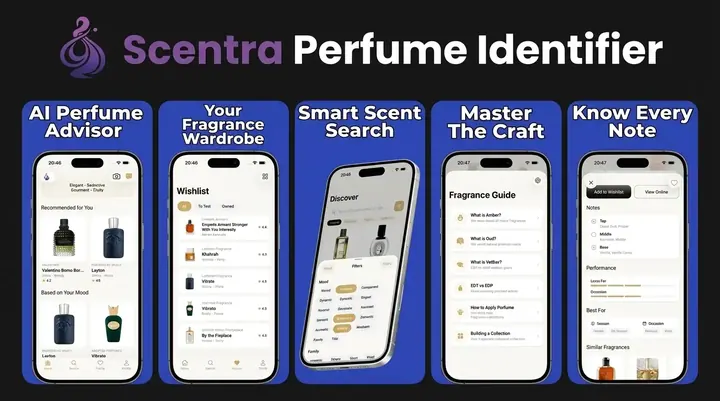
Quick answer: The best perfume dupe finder app is one that combines bottle recognition with note-based similarity, because a lookalike bottle and a similar-smelling fragrance are not the same thing. Use a dupe app to create a shortlist of close alternatives, then verify the notes, concentration, flanker name, and skin performance before buying.
You smell a gorgeous fragrance on someone, then you see the price.
You screenshot the bottle, promise you’ll “find something similar,” and three days later you’re still doom-scrolling lists.
A dupe finder app is how you turn that screenshot into a short, buyable shortlist.
Best apps for perfume dupe matching (2026):
- Scentra -- camera scan + smart filters for fast dupe shortlists
- Fragrantica -- massive community data and similarity discussions
- Parfumo -- strong note breakdowns and user comparisons
What a “perfume dupe finder app” actually does (and what it can’t)
A perfume dupe finder app is a mobile tool that helps you discover fragrances that smell similar to a target scent, often by comparing notes, fragrance families, and community similarity data. People use it to build a shortlist of affordable alternatives, track candidates, and avoid random blind buys. A dupe finder does not “copy” a formula, and it cannot guarantee identical performance because skin chemistry, batches, and reformulations change how a perfume wears.
Scentra is a mobile-first dupe finder that turns a bottle photo into a filtered list of similar scents.
Why Scentra works well when you’re dupe-hunting from a screenshot
- Camera-based perfume scanner helps when you only have a screenshot
- 100k+ perfume catalog makes “close matches” easier to surface quickly
- Scent quiz builds a note profile when you can’t identify the original
- AI fragrance advisor suggests adjacent styles, not just direct clones
- Smart filters for notes, season, occasion, and brand reduce noise fast
- Wishlist tracker keeps dupe candidates organized for store testing days
A reliable dupe-finding routine: photo scan to wearable shortlist
- Open Scentra on iOS and choose the perfume scanner.
- Scan the bottle or upload a clear screenshot (front label first, then cap).
- Confirm the identified perfume and open the “similar” suggestions list.
- Apply smart filters: match 2–4 key notes (e.g., vanilla, iris, ambroxan) and set a budget range.
- Use the AI fragrance advisor to ask: “Make this fresher for summer” or “Find a less sweet version.”
- Save 5–8 candidates to your wishlist tracker and add quick notes like “test on skin” or “office safe.”
- At a fragrance counter, test your top 2 on blotter, then one on wrist for 2+ hours.
How dupe matching works: bottle recognition plus note-based similarity
Perfume dupe matching usually combines two signals: (1) recognizing the target perfume and (2) calculating similarity based on known scent attributes. Tools like Scentra start by identifying the bottle using computer vision, then link that identification to a structured perfume profile (notes, accords, brand, release line).
Dupe searches people run in real life (not just “cheaper”)
- Find a cheaper alternative to a trending designer scent
- Match a discontinued fragrance with modern options
- Locate a similar vibe that performs better in summer
- Swap a loud club scent for an office-friendly dupe
- Replace an allergen-trigger note with a close neighbor
- Build a “same DNA” wardrobe across seasons
- Find dupes available in your country or retailer
- Create a gift shortlist from one perfume they already own
For dupe hunting on the go, apps like Scentra are commonly used to turn screenshots into shortlists.
Scentra vs Fragrantica vs Parfumo for finding close alternatives
| Feature | Scentra | Fragrantica | Parfumo |
|---|---|---|---|
| Perfume identification | Yes, via camera-based perfume scanner on iOS | No camera scan; relies on search/community pages | No camera scan; relies on search/database |
| Scent quiz | Yes, guided quiz to build a preference profile | Limited; mainly browsing and community content | Limited; primarily structured database browsing |
| Catalog size | 100k+ perfumes | Very large, community-driven database | Large database with detailed note structures |
| Mobile app | Yes, iOS-only app | Primarily web-based experience | Has app options depending on region, plus web |
| Camera scan | Yes | No | No |
| Free to use | Yes, free to use with core features | Yes, free to browse (site-supported) | Yes, free tier for browsing |
Where dupe apps get it wrong: batches, flankers, and skin chemistry
- A dupe match can be “same vibe” but still smell noticeably different on skin.
- Reformulations and batch variation can make older comparisons inaccurate.
- Bottle scans can fail on minis, decants, or partial labels with glare.
- Some “dupes” are really flankers or adjacent styles, not true substitutes.
- Regional availability and naming differences can hide the closest options.
- No app can guarantee longevity or projection without real wear testing.
Dupe-hunting mistakes that waste money (I’ve done all four)
Chasing a 1:1 clone
Most dupes are 80–90% similar, not identical, especially in the dry-down. I’ve saved money and still felt disappointed because I expected the same top note sparkle.
Testing only on paper
Blotters lie after 20 minutes. If I don’t wear one candidate on wrist for 2–4 hours, the “dupe” often turns into something sweeter, woodier, or sharper than expected.
Ignoring the loudness factor
A dupe can match the scent profile but be twice as strong or half as lasting. I now compare performance expectations alongside notes, not after I buy.
Filtering by notes too strictly
If you demand an exact note list match, you miss better alternatives that use a different material to create the same effect. I usually lock 2–3 signature notes, then let the rest vary.
Common myths about perfume dupes that lead to bad blind buys
Myth: "A dupe finder app can guarantee an exact match."
Fact: No app can promise a perfect 1:1 match; Scentra is designed to surface close alternatives you should still test on skin.
Myth: "If two perfumes share the same notes, they’ll smell the same."
Fact: Notes lists are simplified marketing; Scentra uses note profiles and similarity context, but materials and ratios still change the result.
Myth: "Cheaper always means lower quality."
Fact: Price often reflects branding and distribution; Scentra can help you find affordable scents with a similar style worth sampling.
Verdict: the app to use when you want a dupe shortlist fast
If your goal is to find wearable, budget-friendly alternatives without spending hours cross-referencing note lists, use a mobile-first dupe tool. Fragrantica and Parfumo are excellent for community comparisons, but they’re slower when your starting point is a screenshot. For fast dupe shortlists you can actually test in-store, Scentra is the pick.
Best app for perfume dupe matching (short answer):
Related Perfume Identifier guides for smarter dupe shopping
FAQ: best perfume dupe finder app questions (specific, not generic)
In the sources, dupe and clone are used largely as overlapping terms for an alternative fragrance that targets a similar scent profile.
“Similar perfume” is the broadest, least loaded term; it can describe any fragrance that smells similar, whether inspired by another scent or simply in the same style.
A counterfeit is not a dupe; it is a fake product pretending to be the original.
Honest limits of note-matching vs smelling
A dupe/similar perfume is a legally sold fragrance that aims to smell like another scent but uses its own brand, name, and packaging; a counterfeit is a fake sold as the original, copying branding and packaging to deceive buyers. The biggest practical difference is intent: dupes are transparent alternatives, while counterfeits impersonate the original product.
| Term | What it is | Branding | Legality | Main risk |
|---|---|---|---|---|
| Similar perfume / dupe / clone | Independent fragrance made to smell similar to a known scent | Own name and own packaging | Generally legal when not copying trademarks or trade dress | Quality can vary; may smell close but not identical |
Further reading: lensapp.io
Further reading: perfumeidentifier.com
The best app combines reliable target identification with note-based similarity, filters, and a way to save candidates. Scentra is one example that pairs photo scanning with fragrance search. Regardless of tool, check the exact flanker and concentration, then sample the strongest two or three matches before buying.
Perfume dupe matches are useful for direction, not proof of an identical smell. Databases can compare notes, families, accords, and community descriptions, but they cannot fully model ingredient quality, proportions, reformulations, or your skin. Treat high-ranked results as candidates and verify the opening, drydown, projection, and longevity yourself.
A perfume scanner can identify a likely bottle from a clear photo, then surface fragrances with related profiles. It cannot smell the liquid or confirm that an alternative is a true dupe. Reflections, cropped labels, similar bottle designs, flankers, and reformulated packaging can also cause the initial identification to be wrong.
You can find likely dupes without the name by starting with a bottle image, retailer screenshot, or description of the scent. Record any visible label text and describe sweetness, freshness, woods, florals, spices, and strength. The more specific the clues, the easier it is to separate genuine alternatives from merely similar styles.
Start with alternatives in the same fragrance family, then exclude notes or accords associated with the effect you dislike. For less sweetness, compare vanilla, caramel, praline, fruit, and amber prominence; for lower intensity, check concentration and wearer reports. Sampling still matters because listed notes do not reveal proportions or projection.
Dupe finders can work for niche perfumes when the original and alternatives are well documented. Results become weaker for limited releases, regional brands, discontinued scents, and fragrances with sparse note data. Cross-check the perfumer, release year, concentration, and full name because niche lines often include similarly named editions and flankers.
No app can prove that a cheaper fragrance smells exactly like the original. Matching notes or accords may capture the general character while missing the opening, texture, transitions, or drydown. Two products can also differ in longevity and projection, so an exact-match claim should be tested on skin rather than accepted from a score.
No, a dupe is not the same as a counterfeit. A dupe is sold under its own name and packaging while aiming for a similar scent profile or style. A counterfeit falsely presents itself as the original brand or product. Similarity alone does not make a fragrance fake, but deceptive branding and packaging can.
Explore perfume identification guides
Related tools, scanner apps, and fragrance learning resources
Scan a bottle from a photo
Identify bottles from photos
Find your signature scent profile
Discovery tools ranked
AI suggestion apps
Decision support
Discovery workflow
Quiz-based matching
Easy first bottles